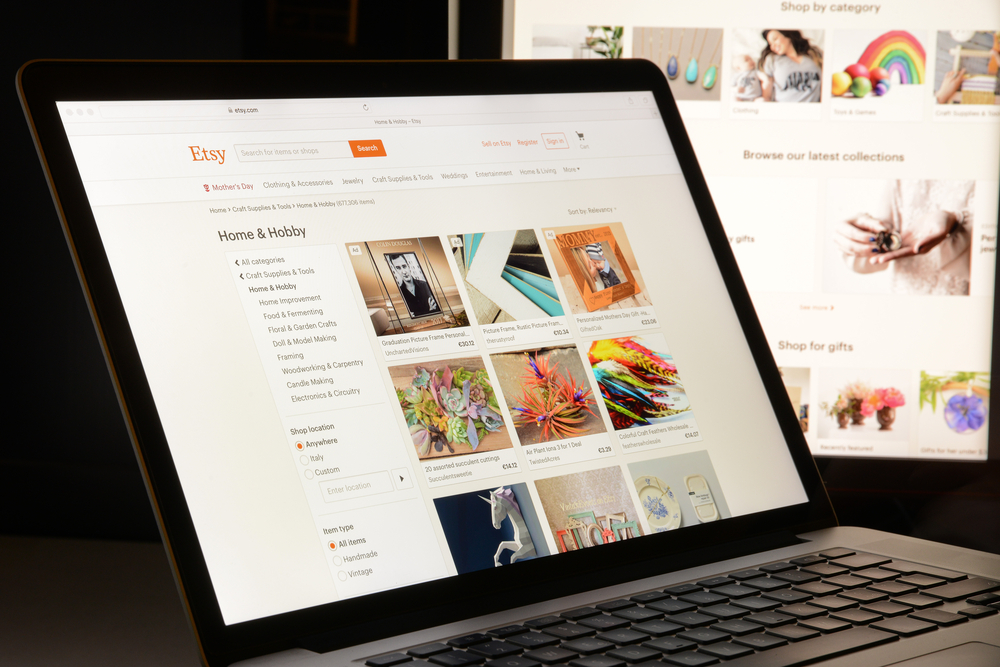

Artificial intelligence has quickly become part of the workflow for many online sellers. Etsy sellers are using tools such as ChatGPT and AI image generators to brainstorm product ideas, create artwork, edit product photos, write descriptions, and speed up other parts of running an online business.
Now Etsy is putting clearer boundaries around how those tools can be used.
On October 22, 2026, Etsy announced a significant update to its policies surrounding artificial intelligence, including new rules for listing photos, AI-generated products, automated listings, patterns, instructions, recipes, and other digital products.
The good news is that Etsy is not banning AI.
Instead, Etsy says AI should support a seller’s creativity rather than replace the seller altogether. The company’s updated policies focus heavily on transparency, human involvement, and making sure buyers receive what they believe they are purchasing.
For Etsy sellers, especially those selling print-on-demand products or digital downloads, there are several important changes worth understanding.
Why Etsy Is Changing Its AI Policies
AI-generated content has exploded across ecommerce marketplaces over the past few years.
That growth has created a problem for marketplaces such as Etsy: buyers increasingly have difficulty determining whether the products, artwork, photographs, and sellers they see are authentic.
Etsy says many active buyers have reported that they cannot tell which items involve AI-generated content and that this uncertainty has become one of the top barriers preventing some customers from shopping more frequently on Etsy.
At the same time, Etsy sellers have raised concerns about authentic handmade and independently designed products competing against mass-produced or automatically generated AI listings.
Etsy’s response is essentially to establish a clearer dividing line:
AI can assist a creator, but there still needs to be a creator behind the product.
That distinction runs throughout the company’s new rules.
Etsy Still Allows AI-Generated Artwork
One of the biggest misconceptions sellers may have about this announcement is that Etsy is banning AI artwork.
It isn’t.
Etsy continues to allow what it calls seller-prompted AI creations.
For example, a seller could create an original concept, write their own prompts, generate artwork with an AI image generator, refine and curate the results, and then sell the finished design.
Etsy specifically gives examples such as an AI-generated fantasy scene based on a seller’s original prompt or an AI-generated custom portrait of a customer’s pet.
However, there is an important requirement.
If an item was created using AI, the seller must disclose the use of AI in the listing description.
That disclosure requirement isn’t something sellers should ignore or bury.
If AI plays a meaningful role in creating the product itself, Etsy expects buyers to be told.
Fully Automated AI Listings Are Now Prohibited
This may be one of the biggest changes for sellers trying to build highly automated Etsy businesses.
Etsy now explicitly prohibits what it describes as bot-generated AI content.
According to Etsy, each product must include direct human involvement through individual prompting, curation, and creative input. Mass-producing products or listings automatically through scripts or other automation without individualized human oversight is prohibited.
That could have major implications for some of the “automated Etsy shop” strategies being promoted online.
For example, imagine a system that automatically generates hundreds of AI images, creates product titles and descriptions, connects those designs to print-on-demand products, and publishes them to Etsy without someone meaningfully reviewing or developing each product.
That type of workflow appears to be exactly what Etsy is trying to prevent.
Automation itself isn’t necessarily the problem. Sellers can still use tools to make running a business more efficient.
The issue is when the automation effectively becomes the creator.
AI-Generated Patterns, Recipes and Instructional Guides Are No Longer Allowed
Digital sellers should pay particularly close attention to this part of the announcement.
Etsy now prohibits AI-generated functional instructions.
This category includes products whose primary purpose is helping someone accomplish a specific task or achieve a particular result.
Examples include crochet and knitting patterns, sewing and embroidery patterns, recipes, woodworking plans, assembly manuals, instructional guides, and instructional ebooks.
This distinction is important.
You might be able to use AI to help brainstorm topics, organize information, correct grammar, or assist with editing. But the actual instructions buyers rely on need to be your own work.
The reason Etsy gives is fairly straightforward: inaccurate AI-generated instructions can cost buyers time, money, and materials before they realize something is wrong.
If you’re selling patterns, recipes, plans, or instructional digital products, this is an area where you should carefully review your existing inventory.
Etsy Is Also Cracking Down on AI Product Images
Product images are another major focus of the new policy.
For most physical products, Etsy now requires sellers to include at least one completely unedited photograph of the actual product against a real background.
That photo cannot have its background replaced, have AI enhancements applied, or otherwise be digitally changed.
Additional listing photos can still be edited.
Etsy specifically allows sellers to use traditional photo-editing software or AI tools for things such as adjusting lighting, correcting color, cropping, resizing, straightening photographs, or replacing backgrounds.
But there is an important limitation.
Those edits cannot materially change the product.
You cannot use AI to make the product appear to have a different texture, color, condition, quality, or design than the actual item the customer will receive.
For sellers using AI-generated lifestyle scenes and product photography, that means accuracy is becoming increasingly important.
What About Print-on-Demand Sellers?
This is one area where the new rules could initially sound alarming.
If you’re using Printify, Printful, or another production partner, you probably aren’t ordering and photographing every single product variation you offer.
Fortunately, Etsy specifically provides an exception for print-on-demand products.
When a production partner prints your original design onto a standard product such as a shirt or mug, Etsy says sellers may use an authorized stock-photo mockup.
That is an important distinction for POD sellers.
It means the new requirement does not suddenly require every Printify or Printful seller to order physical samples of every product before publishing a listing.
However, the mockup still needs to accurately represent what the customer will receive.
For example, using AI to place your design onto a completely different style of shirt, dramatically changing the garment color, modifying the print size, or creating an unrealistic representation of the finished product could potentially create problems.
For POD sellers, realistic mockups are going to become even more important.
What About AI Models Wearing Your Products?
This is another area worth watching.
AI-generated models have become extremely popular with clothing sellers because sellers can create lifestyle images without organizing expensive photoshoots.
Etsy has not completely prohibited AI-edited listing images.
However, the image still needs to accurately represent the actual product.
Etsy also recommends that sellers disclose in their listing description when AI has been used to edit listing images. At this point, Etsy describes that particular disclosure as a best practice, rather than the same explicit requirement that applies when the product itself was created using AI.
Sellers should therefore be careful about using AI models or lifestyle scenes that distort the actual fit, print placement, garment shape, color, or other product characteristics.
The safest approach is to make sure customers can clearly distinguish what the actual product looks like.
Digital Downloads Have Their Own Rules
Digital products are treated somewhat differently because there may not be a physical item to photograph.
Etsy says digital downloads generally need a visual preview or excerpt showing what buyers will receive.
For digital products without meaningful visual content, such as some audio files, Etsy allows representative images—including AI-generated images—as long as those images do not mislead buyers about what they are purchasing.
Again, transparency is the theme.
The listing image should help buyers understand the product, not create an imaginary version of something they aren’t actually receiving.
AI Prompt Bundles Are Still Not Allowed
If you’ve considered selling collections of Midjourney, DALL-E, ChatGPT, or other AI prompts as digital products, Etsy’s position remains clear.
AI prompt bundles are prohibited.
Etsy considers the prompts used to produce AI artwork part of the creative process rather than a standalone product that fits its marketplace standards.
That doesn’t mean sellers can’t sell finished artwork created using their own AI prompts.
They can.
The distinction is between selling the finished creative work and simply selling collections of prompts used to generate it.
Etsy Is Increasing AI Detection and Enforcement
The policy changes aren’t only words on a policy page.
Etsy says it is also investing in systems designed to identify potentially misleading AI imagery and fraudulent AI-generated inventory.
When Etsy detects an image that appears AI-generated during the listing process, sellers may begin seeing guidance explaining how to comply with the platform’s image requirements.
Etsy says this guidance will eventually expand to existing listings as well.
Etsy is also adding a reporting option that allows shoppers and other Etsy members to flag listings they believe contain misleading AI imagery.
Initially, Etsy says these reports will be used to better understand potential AI misuse and will not automatically result in enforcement.
However, Etsy has made it clear that it intends to become more proactive about identifying policy violations over time.
Listings can be removed, and severe or repeated violations can ultimately result in a shop being closed.
What Etsy Sellers Should Do Now
If you currently sell on Etsy, especially if AI plays any role in your workflow, this is a good time to audit your shop.
Here are the areas I would review first:
- Review product photos. Make sure your physical-product listings meet Etsy’s new image requirements or qualify for one of its exceptions.
- Check your POD mockups. Make sure mockups accurately represent the garment or product buyers will actually receive.
- Disclose AI-generated products. If AI was used to create the product or artwork itself, disclose that fact in the listing description.
- Review digital instructional products. Patterns, recipes, project plans, instructional ebooks, and similar products cannot rely on AI-generated instructions.
- Avoid fully automated listing systems. AI can help with your workflow, but Etsy expects meaningful human involvement in each product.
- Review AI lifestyle images. Make sure generated models, backgrounds, or environments aren’t creating unrealistic expectations about the product.
- Don’t sell AI prompt bundles. Etsy specifically prohibits them.
- Keep documentation of your creative process. While Etsy doesn’t require sellers to publish their entire workflow, maintaining original files, prompts, photographs, and design files could be helpful if a listing is incorrectly flagged and you need to appeal.
Does This Mean Sellers Should Stop Using AI?
No.
In fact, Etsy itself uses AI throughout its platform and has introduced AI-powered tools designed to help sellers manage their shops.
The message from Etsy isn’t that sellers shouldn’t use artificial intelligence.
The message is that AI should remain a tool rather than becoming the seller.
That’s an important distinction.
Using AI to brainstorm product concepts, improve grammar, edit photography, help develop marketing copy, generate ideas, or assist with the creative process can make a small ecommerce business much more efficient.
Problems begin when AI is used to deceive customers, fabricate products, completely automate creative output, or create instructions that haven’t been developed and verified by the seller.
The Bigger Picture for Etsy Sellers
I think this update provides a good indication of where online marketplaces are headed.
AI-generated products aren’t going away.
Instead, platforms will probably become more focused on proving authenticity, identifying human involvement, and giving buyers better information about how products were created.
For legitimate sellers, that isn’t necessarily bad news.
One of the biggest challenges on platforms such as Etsy has been competing against shops capable of publishing enormous quantities of low-effort products.
If Etsy’s enforcement works as intended, requiring meaningful human involvement could make it harder to flood the marketplace with thousands of automatically generated listings.
For side hustlers, the strategy shouldn’t be to avoid AI.
It should be to use AI to become more productive without removing yourself from the creative process.
AI can help you work faster.
Your ideas, judgment, quality control, product knowledge, and creativity still need to be what separates your shop from everyone else.
And based on Etsy’s latest policy changes, that human element is becoming more important than ever.